How to Choose a Legitimate Roofing Contractor
Red flags like storm chasers and deductible-waiver offers, what a legitimate roofing contract should include, how to verify licensing and insurance, warranty types explained, and how payment schedules and mortgage co-endorsements work.
The period right after storm damage is when homeowners are most vulnerable to bad actors — and it's also when the largest financial decision in the whole claims process gets made. This guide covers how to spot the contractors worth avoiding, what a legitimate contract actually looks like, how to verify a contractor is who they say they are, and how payment and warranties typically work.
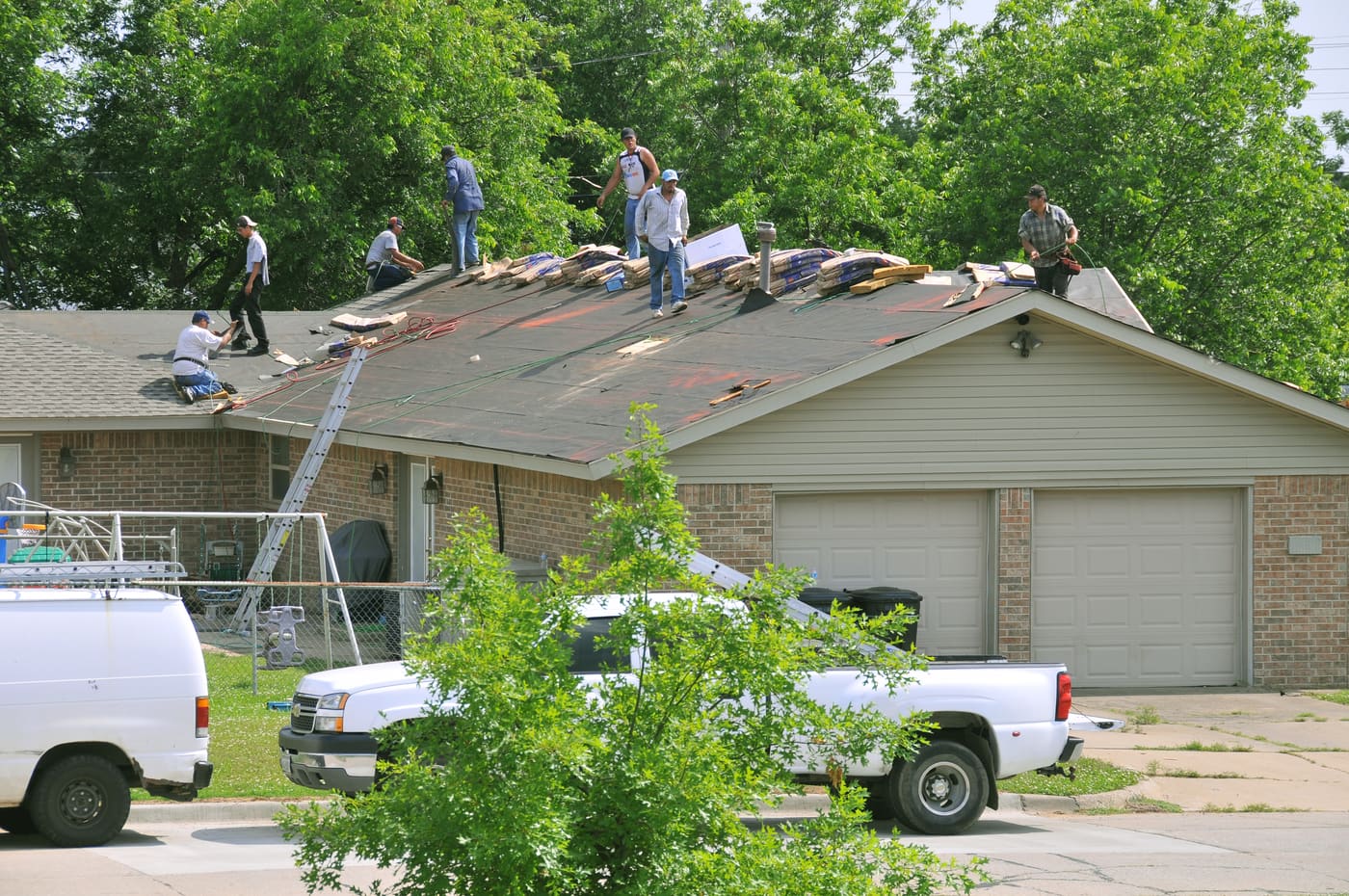
A crew mid-replacement. A legitimate roofer's work — and paperwork — should look this organized. Photo: FEMA (public domain)
Red flags to watch for
Storm chasers. These are contractors — sometimes local, often traveling crews who follow major hail and wind events from region to region — who canvass neighborhoods immediately after a storm, going door-to-door offering free inspections and fast signups. The traveling pattern itself isn't automatically disqualifying, but it does mean you have much less ability to verify local reputation, check references from past local customers, or get warranty service after the crew has moved on to the next storm.
"We'll waive your deductible." This is one of the clearest red flags in the entire industry. A legitimate contractor charges what the job actually costs; your deductible is part of that cost, and you're responsible for it under your policy. A contractor offering to absorb or waive it is either padding the invoice elsewhere to make up the difference (which can constitute insurance fraud) or won't actually deliver — and in many states this practice is illegal outright. Treat this offer as an immediate disqualifier.
Pressure to sign immediately. Legitimate contractors expect you to compare quotes and think it over. High-pressure tactics — "this price is only good today," refusing to leave without a signature, discouraging you from getting other quotes — are consistent with a sales-first, not craftsmanship-first, operation.
Requesting an assignment of benefits (AOB) before any inspection. As covered in the FAQ above, an AOB transfers your right to negotiate directly with your insurer to the contractor. Being asked to sign one before an adjuster has even inspected the property, or without a clear explanation of what you're signing, is a warning sign.
No permanent local address or unclear business identity. A legitimate local contractor has a verifiable business address, a consistent business name across their contract, insurance certificate, and any online presence, and references you can actually call.
Vague or missing scope of work. A quote that says "roof replacement — $X" without specifying materials, underlayment, ventilation components, flashing, and cleanup terms leaves too much room for disputes later.
Cash-only or upfront-in-full payment demands. Legitimate contractors typically work on a staged payment schedule tied to project milestones, not full payment before work begins (see payment schedules below).
Verifying licensing and insurance
Before signing anything, verify independently — don't just take the contractor's word or the certificate they hand you at face value:
- Contractor license. Licensing requirements vary significantly by state (some states license roofers specifically, others fold roofing into a general contractor license, and a few states have minimal licensing requirements at all). Check your state's contractor licensing board website directly and search for the business by name and license number.
- General liability insurance. Ask for a certificate of insurance and verify it directly with the insurance carrier listed — call the carrier or check their portal rather than relying solely on the document, since certificates can be outdated or falsified.
- Workers' compensation coverage. This protects you if a worker is injured on your property. Ask for proof and verify it the same way as liability insurance.
- Local business registration, if your state or municipality requires it separately from a contractor license.
- References from local jobs, ideally recent ones, and ideally ones you can actually visit or call directly rather than only reading provided testimonials.
What a legitimate contract should include
A solid roofing contract should specify, at minimum:
- The contractor's full legal business name, license number, and contact information.
- A detailed scope of work: tear-off details, underlayment type, shingle/material brand and type, ventilation components, flashing work, and cleanup/disposal terms.
- Start and estimated completion dates.
- Total price, payment schedule, and what triggers each payment.
- Warranty terms, both for materials (manufacturer warranty) and workmanship (contractor warranty) — see below for the difference.
- Change-order terms: how additional costs discovered mid-project (like unexpected decking damage) will be communicated and approved.
- Whether a mortgage co-endorsement applies to insurance payments (see below) and how that affects the payment schedule.
Warranty types, explained
Roofing warranties generally break down into two distinct categories, and it's worth understanding both:
- Manufacturer's warranty. Covers defects in the roofing materials themselves (shingles, underlayment, etc.), provided by the material manufacturer, not the contractor. Terms and length vary by manufacturer and product line, and some manufacturers offer enhanced warranties only if the installation is done by a certified installer for that product line.
- Workmanship warranty. Covers the quality of the installation itself, provided by the contractor, not the manufacturer. This is the warranty most directly tied to the specific company you hire — if they go out of business or you can't reach them, a workmanship warranty can become difficult or impossible to enforce, which is another reason local reputation and longevity matter.
Ask specifically: what's covered by whom, for how long, and what would void either warranty (for example, certain manufacturer warranties can be voided by improper ventilation or using non-certified installers).
Payment schedules and mortgage co-endorsements
Legitimate contractors typically structure payment in stages rather than requiring full payment upfront — commonly something like a modest deposit at signing, a payment at material delivery or project start, and a final payment upon completion and your sign-off. Be cautious of any contractor requiring full payment before work begins.
If your roof replacement is being paid for through an insurance claim and you have a mortgage, your insurer will often issue the claim payment as a check made out jointly to you and your mortgage lender — this is called a mortgage co-endorsement or loss-payee arrangement, and it exists because the lender has a financial interest in the property being properly repaired. If this applies to you:
- Contact your mortgage servicer's insurance/loss-draft department as soon as you receive the claim check — they'll typically explain their specific process for endorsing and releasing funds.
- Expect the lender to release funds in stages, often tied to inspections confirming work completion, similar to your contractor payment schedule.
- Build this timeline into your conversation with your contractor from the start, since a lender's fund-release process can take longer than a simple bank deposit.
Getting and comparing multiple quotes
Getting at least two or three quotes isn't just about finding the lowest price — it's a practical way to sanity-check scope, materials, and claims made by any single contractor. When comparing quotes side by side, look past the bottom-line number and check whether each one specifies the same scope of work. A noticeably lower quote is often lower because it's omitting something — underlayment upgrades, proper ventilation components, code-required flashing, or full cleanup and disposal — not because the contractor is simply more efficient. Ask each contractor to walk you through their number line by line if two quotes differ significantly, and don't be afraid to go back to a contractor with specific questions raised by a competing quote.
It's also reasonable to ask each contractor for their read on the same piece of documentation — for example, whether they'd classify a specific area of damage as functional or cosmetic, or whether they think full slope replacement is needed for matching reasons. Consistent answers across multiple independent contractors carry more weight than a single opinion, especially if your claim ends up disputed.
Questions worth asking during the initial visit
- Are you licensed in this state, and can I have your license number to verify it myself?
- Can you provide a current certificate of insurance for general liability and workers' compensation that I can verify directly with the carrier?
- Can you provide at least two or three references from local jobs completed in the last year?
- What specific manufacturer products and warranty tier are you proposing, and are you a certified installer for that tier?
- What does your workmanship warranty cover, and for how long?
- What's your payment schedule, and what triggers each payment?
- How do you typically handle unexpected issues found during tear-off, like damaged decking, and how would that affect price and timeline?
- Will you be the crew doing the work, or is this subcontracted — and if subcontracted, who's responsible for warranty claims afterward?
A contractor who answers these directly and specifically, and doesn't seem bothered by being asked, is telling you something useful in itself. Reluctance, vagueness, or pressure to skip past these questions is consistent with the same red flags covered above.
Taking the time to vet a contractor properly — checking licensing, insurance, references, and contract terms — is the single highest-leverage thing you can do to avoid the most common and most costly mistakes in the entire claims process.
Not sure where your claim stands?
Get matched with a vetted local roofer who documents damage the way adjusters expect to see it.
Frequently asked questions
In many states, yes — waiving or offering to absorb a policyholder's deductible can constitute insurance fraud, because it effectively misrepresents the true cost of the job to the insurer. Rules vary by state, but the offer itself is one of the most reliable red flags of a contractor you should not work with, regardless of the exact legal technicality where you live.
Last updated July 22, 2026