The Adjuster Says No Damage, But My Roofer Disagrees
When the insurance adjuster and your roofing contractor reach opposite conclusions, neither is automatically right. Here's how to break the tie: reinspection, better documentation, and the escalation ladder.
This is one of the most common — and most fixable — impasses in a roof claim. The adjuster spent 20 minutes on your roof and found nothing qualifying; your roofer says it's storm-damaged. Someone is wrong, and neither title settles which.
Why honest professionals reach opposite conclusions
The two aren't always answering the same question. An adjuster is applying claim criteria: functional damage, from a covered peril, in qualifying density (many carriers count hail hits within a 10'×10' test square per slope). A roofer is often answering "does this roof have problems worth fixing?" A roof can honestly fail the first test and pass the second — old wear plus a handful of real hail hits, for example.
Then there's incentive on both sides: the carrier pays less when claims deny, and the roofer only works when roofs get replaced. Neither bias means either person is lying — but it means documentation, not opinion, should break the tie.
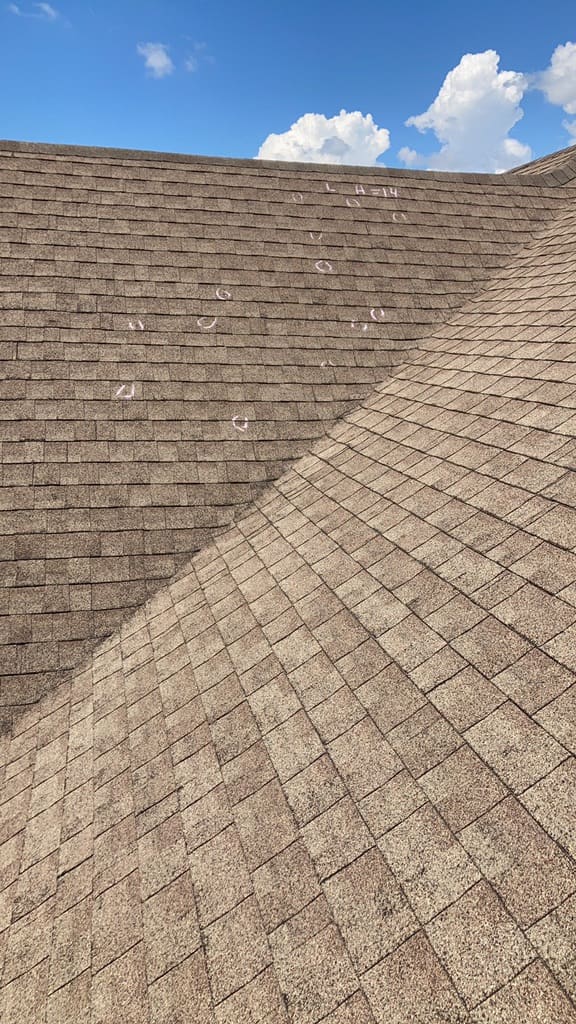
What a documented position looks like: hail hits chalked across a slope during an inspection. Marks like these, photographed hit by hit, are what break ties. Photo courtesy of Yellowhammer Roofing, used with permission.
Your escalation ladder, in order
1. Get the adjuster's report. You're entitled to know what the inspection found and why it didn't qualify. The denial reasons tell you exactly what evidence you need to counter — cosmetic-vs-functional, insufficient hits, or wear and tear each call for different rebuttals.
2. Get your roofer's findings in writing. "There's definitely damage up there" is worthless in a dispute. Useful: dated, close-up photos of specific hits with locations, chalk marks, a slope-by-slope count, and a written statement on letterhead. If your roofer won't produce this, get one who will.
3. Get a true second opinion. A second assessment from an established local roofer — not the one who door-knocked after the storm — either strengthens your case enormously or tells you the claim genuinely lacks merit before you spend months fighting it.
4. Request a reinspection, and be there with your roofer. This is the single highest-leverage move. Carriers grant reinspection requests routinely, and the dynamics change completely when your contractor is on the roof pointing at specific hits while the adjuster looks on. Our adjuster guide covers how to prepare.
5. Escalate formally. If reinspection fails and your evidence is strong: a written appeal with your documentation package, a public adjuster or engineer's report for larger disputes, the policy's appraisal clause for valuation fights, and a complaint to your state's Department of Insurance. The full path is in our denial and appeal guide.
A note on timing
Don't let a disagreement stall you past your policy's deadlines — supplements, appeals, and appraisal demands all have windows, and the clock runs from the storm, not from when the argument ends. Keep every interaction in writing, and keep moving.
Go deeper
Claim Denied? How to Read the Letter and AppealCommon reasons roof claims get denied, how to request a reinspection, how to write a rebuttal, the appraisal clause, and when to file a state complaint or call an attorney.
Not sure where your claim stands?
Get matched with a vetted local roofer who documents damage the way adjusters expect to see it.
Frequently asked questions
Adjusters work for the carrier, and carriers have a financial interest in the outcome — but that doesn't mean every "no damage" finding is wrong. Adjusters apply specific criteria (like qualifying hits per test square) and deny claims that genuinely don't meet them. The productive assumption isn't "the adjuster is lying," it's "the adjuster may have missed something or applied criteria my evidence can challenge" — which points you toward documentation, not accusations.
Last updated July 24, 2026