Was there hail at my address?
Maybe a roofer knocked and said your neighborhood got hit. Maybe you were away during a storm. Here's how to check what actually fell at your address — with the same public records adjusters use.
The official record. Search your state and county by date range for logged hail events, including reported stone sizes and narrative descriptions. This is the database your evidence should ultimately point to — an entry here for your county and date is foundational claim documentation.
The Storm Prediction Center publishes daily maps of every hail, wind, and tornado report. Pick the storm date and look for hail markers near your town — fast for confirming a specific day, and each report lists stone size and location.
Enter your ZIP code to find your local NWS office, which posts event summaries after significant storms — useful narrative documentation of a major hail event in your area.
The catch with public reports: hail is hyper-local
Hail swaths are often only a mile or two wide. A report from your county — even your town — doesn't prove hail hit your street, and the absence of a report doesn't prove it missed you, since reports depend on someone observing and calling it in. Public records establish that a storm capable of producing hail moved over your area; the evidence at your property does the rest.
The evidence at your address
This is what adjusters actually check first, because soft metal doesn't dent itself: gutters, downspouts, window wraps, AC fins, mailboxes, and vents. Add splatter marks on driveways, shredded foliage after the storm, and granules collecting at downspout outlets. If ground-level evidence exists, a roof inspection is worth it; our damage identification guide covers exactly what to look for and photograph, and the printable documentation checklist puts it in working order.
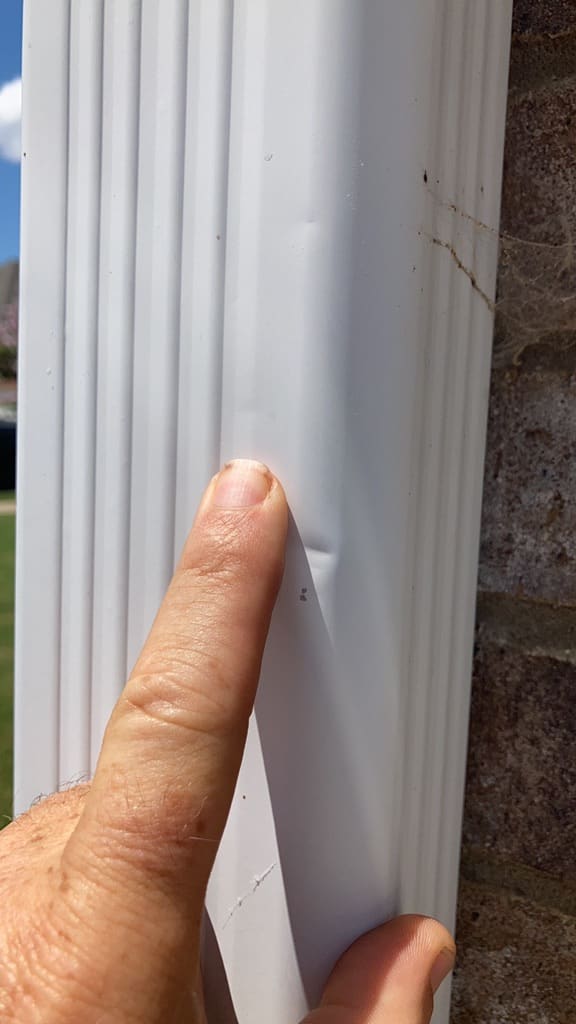
Ground-level evidence: a hail dent in an aluminum downspout. Photo courtesy of Yellowhammer Roofing, used with permission.
What about paid hail history reports?
Roofers and adjusters use commercial services that estimate hail size at a specific address from radar data. They're legitimate tools, but you generally don't need to buy one — if your claim reaches a dispute where radar-derived data matters, your contractor or public adjuster will typically supply it. Start with the free public records and your own photos.
Reports say hail — now what?
Size matters: our breakdown of what size hail damages a roof covers the thresholds by material and roof age. If the reported size and your ground-level evidence line up, get a professional inspection before filing, then follow the filing process — with the storm date from the database as your date of loss.
Not sure where your claim stands?
Get matched with a vetted local roofer who documents damage the way adjusters expect to see it.
Educational information only — not legal, insurance, or public adjusting advice. RoofClaim HQ is not affiliated with any insurance carrier. Every policy and claim is different; confirm specifics with your insurance professional, a licensed public adjuster, or an attorney before making decisions.